
Full-Stack Web Development
We build web applications that are more than a marketing site with a login page — multi-role portals, real-time dashboards, and internal tools designed around how your business actually operates.
- Next.js & React
- API & database architecture
- Performance & SEO optimization
Technologies we use
1.2k
98%
24ms
How we approach full-stack web development
A lot of "web development" work is really front-end work with a thin API behind it. Ours isn't — we design the database schema and API contracts first, because that's what determines whether a platform can handle a second user role, a reporting feature, or a mobile app built on the same backend eighteen months from now without a rewrite.
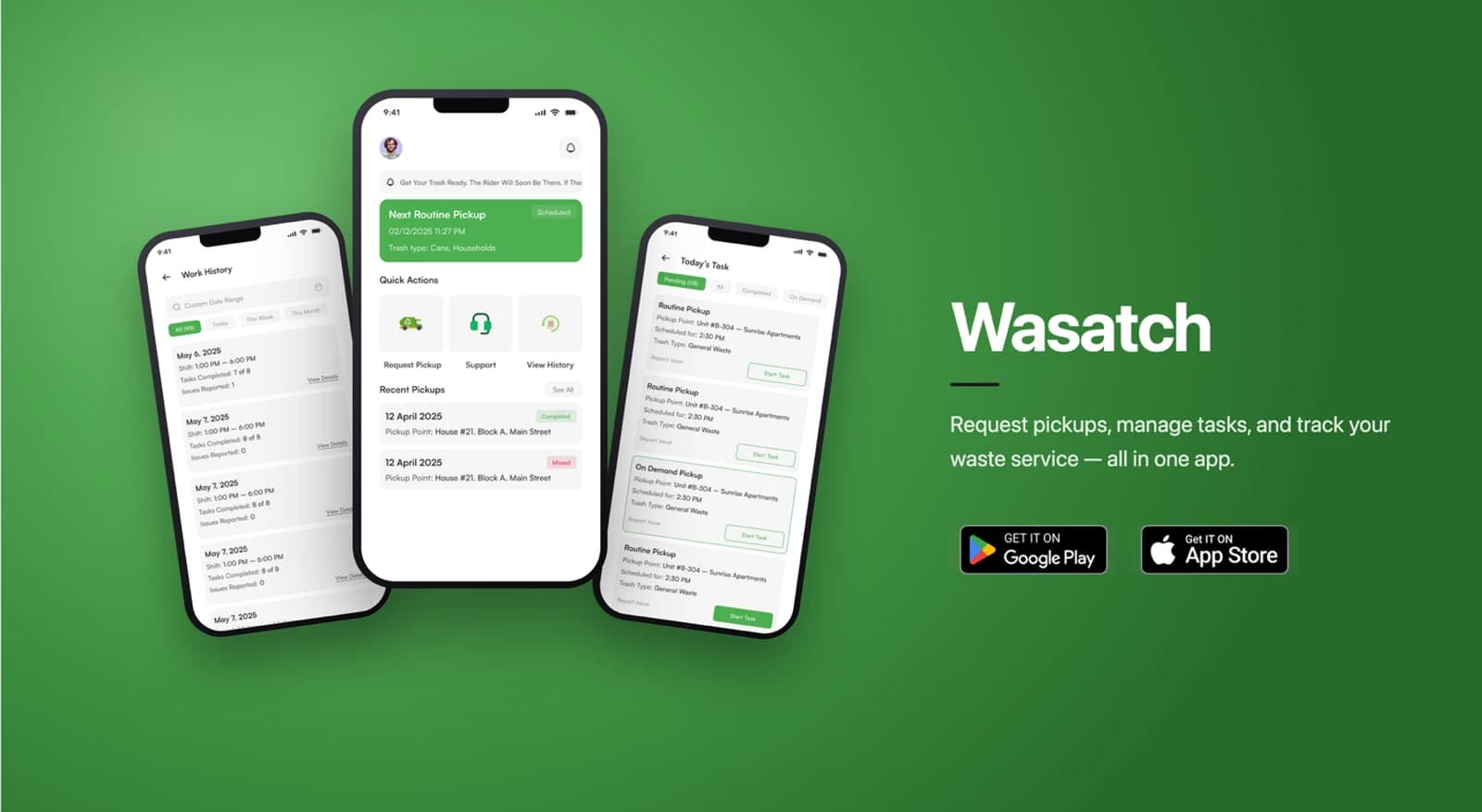
The Wasatch Waste Management System is a representative example: a dual-portal platform where residents submit pickup requests through one interface and field staff manage jobs through another, with an admin layer coordinating both. That kind of multi-role system is where a lot of custom software falls apart — permission boundaries get fuzzy, or the two portals end up as separate codebases that drift out of sync. We build role-based access control and shared data models from the start specifically to avoid that.
We work primarily in Next.js and React on the frontend, with Node.js, PostgreSQL, MongoDB, and Supabase on the backend depending on what the data model and team actually need — a project with heavily relational data gets PostgreSQL, a project with flexible/document-shaped data gets MongoDB, and we're honest about that tradeoff upfront rather than defaulting to one stack for every job.
Performance and SEO aren't treated as a separate workstream bolted on at the end. Server-side rendering, proper meta tags, structured data, and Core Web Vitals are part of how the app is architected from the first sprint — because retrofitting performance into a slow app is far more expensive than building it in from the start.
For businesses replacing a legacy internal tool or spreadsheet-based process, we scope the migration path explicitly: what data needs to move, what workflows can't break during the transition, and how to roll out to real users without a hard cutover that risks losing operational continuity.
Our process
01
Discovery
We map out user roles, data models, and integration points before committing to an architecture.
02
Architecture
Database schema, API design, and auth strategy are locked in early, since these are the expensive things to change later.
03
Build
Iterative delivery with staging environments you can review throughout, not just at final handoff.
04
Test & launch
Load testing, security review, and a production deployment plan that doesn't rely on a risky one-shot cutover.
05
Support
Monitoring, bug fixes, and roadmap-driven feature work after launch.
Ready to talk full-stack web development?
Tell us what you're building and we'll put together a scoped plan within one business day.